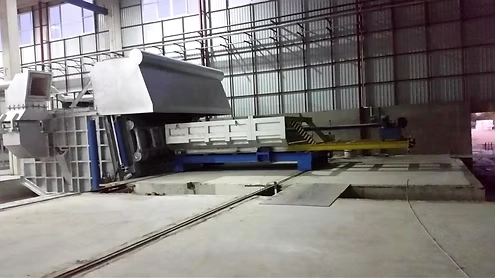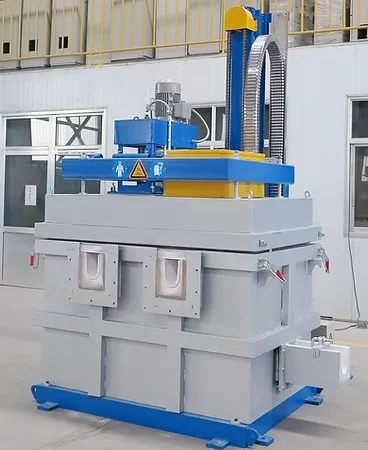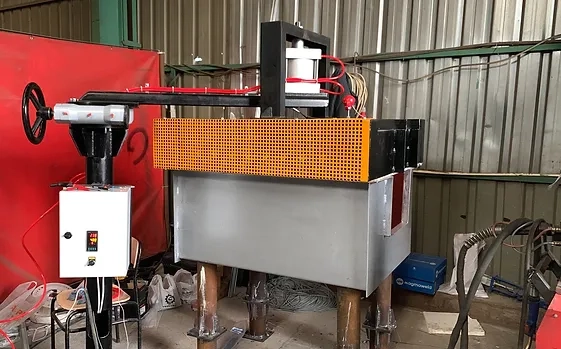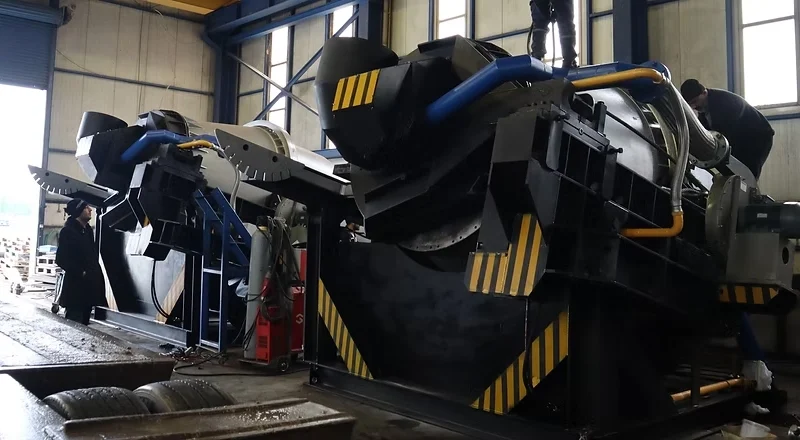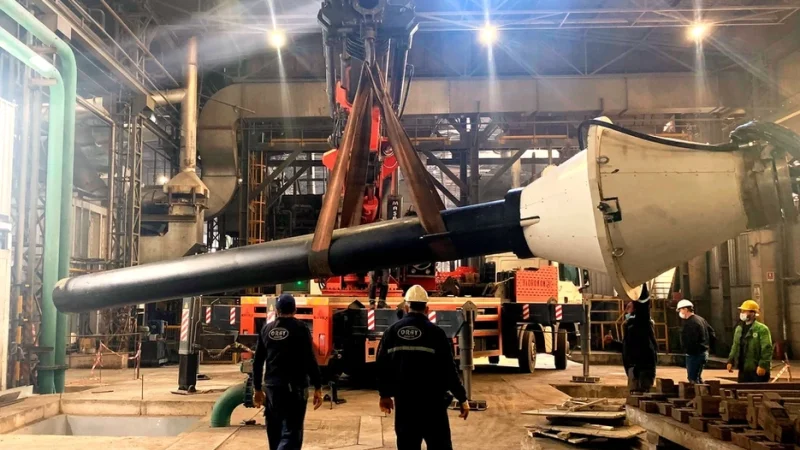
The aluminum billet casting machine is designed for the semi-continuous casting of billets from molten aluminum and aluminum alloys using a vertical casting process. Engineered for heavy-duty, 24/7, year-round operation, the DC (Direct Chill) casting machine incorporates state-of-the-art internally guided hydraulic cylinders.
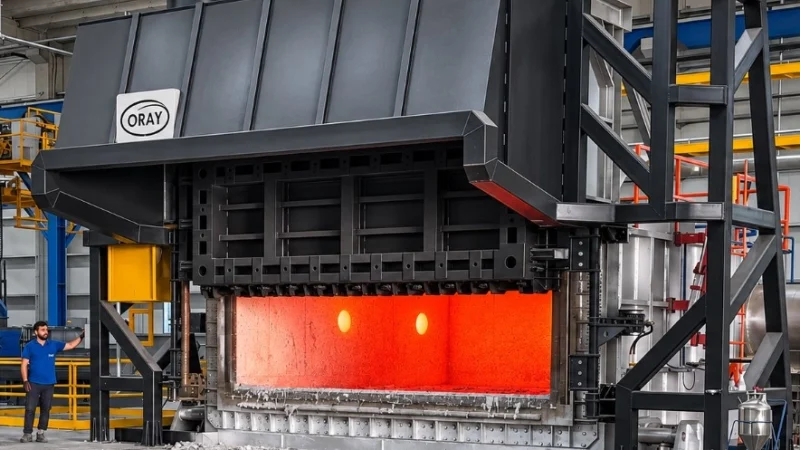
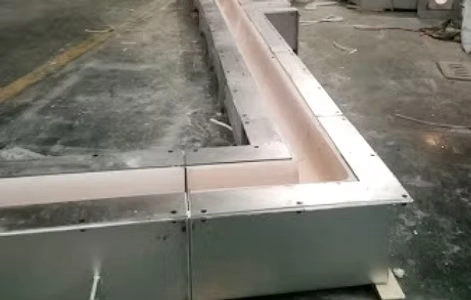
Molten metal is fed from a tilting furnace through a launder system into a distribution basin (trough) located on the casting table. From this basin, the molten metal flows through horizontal channels into water-cooled, “hot-top” molds. Mathematical modeling of the fluid flow has proven to be an essential tool in designing the distribution basin, ensuring a consistent inlet velocity across all casting channels and guaranteeing an even distribution of liquid aluminum into each mold.
Furthermore, this improved metal distribution results in a smaller temperature differential between the molds closest to the furnace and those furthest away.
At the start of the casting process, the bottom openings of the molds are sealed using self-centering starter heads (bottom blocks) attached to a starter base plate.
Once the metal reaches the required height within the molds, the operator initiates the downward movement of the base plate. As the aluminum solidifies through indirect cooling, it descends from the molds into the casting pit, where its temperature is further reduced via direct water-spray cooling.
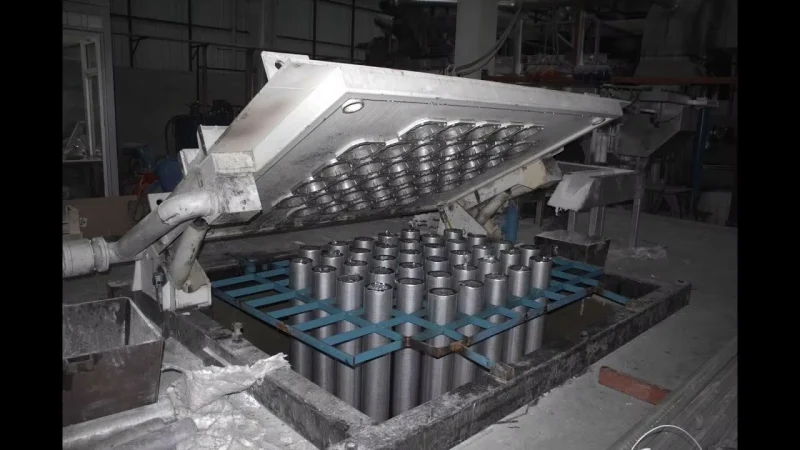
Upon completion of the casting process, the casting table is raised, allowing the billets to be removed from above using an overhead crane. The casting pit, constructed of reinforced concrete on-site, holds water used for the secondary direct cooling of cast products. The water level in the pit is automatically controlled by level switches operating in conjunction with submersible pumps.
The casting machine, complete with hydraulic and water-cooling systems, includes a vertically moving (lifting/lowering) platen and a tiltable water-distribution platen.
The platen assembly consists of a rigid steel structure built from heavy-duty rolled steel profiles and reinforced with stiffening plates. It is operated by a single, centrally mounted hydraulic cylinder, which is anchored to a concrete foundation at the base and connected to the platen’s base frame via a rigid coupling at the top.
Integrated into the upper section of the machine is a tiltable, water-cooled platen constructed from rolled steel profiles. Its tilting mechanism is powered by two hydraulic cylinders connected to the sides of the platen via pivoting brackets.
Tilting brackets equipped with spherical bearings are attached to the edge of the platen, and a rotary joint is installed at the water inlet. Cooling water is distributed around the platen through manifolds fitted with perforated assemblies to ensure uniform cooling across the entire surface.
The hydraulic tilting assembly facilitates the upward and downward movement of the casting platens, driven by two hydraulic pistons.
These hydraulic pistons are connected to two cantilever arms that support the casting platens. The water supply line also passes through these arms, with sealing ensured by rotary sealing elements.